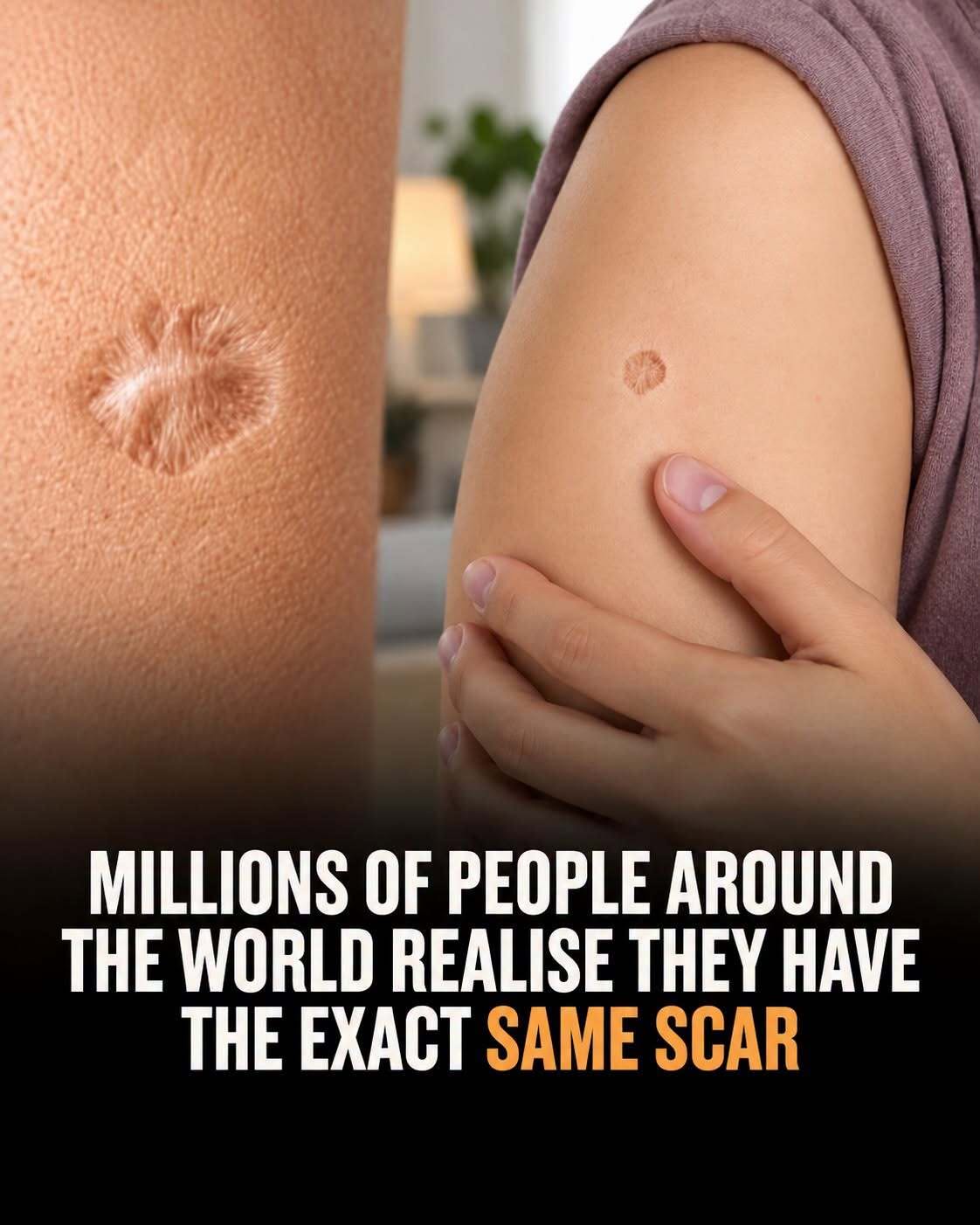
Look closely at the upper arm of someone from an older generation and you may find it.
A small, round scar.
Slightly sunken or raised.
Sometimes smooth, sometimes textured, often no bigger than a coin.
For decades, millions of people barely thought about it. It was simply something they had always carried, like a childhood freckle or an old scrape whose story had been forgotten.
But this scar was different.
For many people, it was left by vaccination against one of the most feared diseases humanity had ever known.
Smallpox.
Long before modern generations grew accustomed to hearing about newly emerging viruses, smallpox had spent centuries moving through communities with devastating efficiency.
It caused fever and profound illness before the characteristic rash developed into fluid-filled lesions across the body.
Those who survived could be left permanently scarred.
Some lost their sight.
Many did not survive at all.
Smallpox didn’t care whether its victims were wealthy or poor, powerful or unknown. It moved through cities, villages, households, armies, and continents.
Generations lived with a reality almost unimaginable today:
Smallpox could arrive.
And if it did, there might be very little anyone could do once infection had taken hold.
The eventual answer was prevention.
Vaccination against smallpox has a history stretching back centuries, but the vaccination campaigns that ultimately helped eradicate the disease relied on a remarkably simple tool.
The bifurcated needle.
It didn’t resemble the conventional injection many people picture when they hear the word “vaccine.”
The needle had two tiny prongs at its tip. A small amount of vaccine could be held between them, and the skin was rapidly punctured multiple times in a small area, usually on the upper arm.
The process was quick.
What followed was much slower.
A local reaction developed.
The vaccination site typically changed over the following days, forming a lesion that eventually crusted and healed.
When healing was complete, a scar could remain.
That little circle became so widespread among vaccinated generations that people stopped seeing anything remarkable about it.
Children compared theirs.
Adults forgot theirs existed.
Doctors recognized it immediately.
Parents saw the same mark on siblings, neighbors, spouses, and friends.
It became ordinary.
But there was nothing ordinary about what it represented.
That scar was evidence of an extraordinary bargain.
A controlled immune response had been deliberately provoked to prepare the body for something far more dangerous.
And multiplied across millions upon millions of people, that individual act of protection became part of something unprecedented.
Humanity began cornering smallpox.
This was not accomplished by one scientist, one country, or one dramatic breakthrough.
Eradication required international cooperation on a scale that is easy to underestimate after the fact.
Vaccines had to reach communities.
Cases had to be recognized.
Health workers had to investigate outbreaks.
Contacts had to be identified.
Surveillance had to improve.
Vaccination teams sometimes traveled into places that were geographically isolated, politically unstable, or extraordinarily difficult to reach.
The strategy became increasingly targeted.
Find the virus.
Contain it.
Vaccinate around it.
Stop its next chain of transmission.
Then do it again.
And again.
Country after country.
Village after village.
Case after case.
The people carrying out that work were not operating in an abstract public-health exercise.
They were trying to find the last hiding places of a killer that had been tormenting human beings for centuries.
Imagine the difficulty.
A suspected case appears somewhere remote.
Someone has to hear about it.
Someone has to reach that community.
Someone has to recognize the disease correctly.
People nearby have to cooperate.
Vaccination has to occur quickly enough to interrupt transmission.
Records have to be kept.
Further cases have to be found.
All of this had to happen without smartphones, instant digital records, satellite internet, or the logistical tools modern health systems often take for granted.
Science supplied the vaccine.
Human beings still had to carry it the final mile.
That distinction matters.
We often talk about medical breakthroughs as though invention automatically produces victory.
It doesn’t.
A vaccine sitting in storage protects nobody.
A treatment unavailable to the person who needs it cannot perform a miracle.
Public health succeeds when knowledge becomes action.
Smallpox eradication required researchers, doctors, nurses, vaccinators, epidemiologists, governments, international organizations, local officials, community leaders, and ordinary families to participate in a common objective.
Not perfectly.
Not without resistance or logistical failures.
Not without enormous difficulty.
But enough.
Eventually, the virus began running out of places to go.
The last naturally occurring case of variola major was recorded in Bangladesh in 1975. The last naturally occurring case of variola minor was identified in Somalia in 1977.
Then came something humanity had never before achieved with a human infectious disease on this scale.
The World Health Organization declared smallpox eradicated in 1980.
Eradicated.
Not merely controlled.
Not reduced.
Not seasonally suppressed.
Gone from natural circulation.
A disease that had killed and disfigured people for generations was no longer passing naturally from human being to human being.
That is what the little scar can represent.
Not invincibility.
Not perfect medicine.
Not proof that every public-health campaign will succeed in the same way.
But proof that coordinated human effort can sometimes accomplish something so enormous that later generations struggle to understand why it was necessary.
That is one of prevention’s strangest paradoxes.
When prevention works extraordinarily well, the danger begins to look imaginary.
A young person today can look at an older relative’s vaccination scar and have no personal memory of the disease that made it necessary.
No childhood friend with smallpox scars.
No neighbor blinded by it.
No school emptied by an outbreak.
No terrified parent checking a child’s skin.
The absence becomes normal.
And because the catastrophe no longer happens, people can forget how extraordinary that absence is.
Routine smallpox vaccination eventually stopped in many countries once the disease was no longer circulating and the balance of risks had changed.
As a result, younger generations often do not carry the characteristic mark.
That creates a fascinating family divide.
A grandmother may have one.
Her daughter may have one.
Her granddaughter may not.
Three generations standing together can carry a visible timeline of medical history on their skin.
“What’s that scar?”
A child might ask.
And suddenly a tiny mark becomes a history lesson.
It tells a story about a world in which smallpox was real.
About vaccination campaigns.
About doctors and health workers searching for cases.
About governments that, despite political divisions, cooperated toward a shared objective.
About parents who brought children forward to be vaccinated.
About communities participating in something larger than themselves.
Of course, not every circular scar on an upper arm is necessarily from a smallpox vaccination. Other vaccines, particularly BCG vaccination against tuberculosis, can also leave characteristic scars, and vaccination practices have differed significantly by country and generation.
So a scar alone cannot always identify its own history.
Ask.
That may be the most valuable thing about noticing it.
Ask your parents.
Ask your grandparents.
Ask where they received the vaccination.
Ask what they remember.
Maybe they remember lining up at school.
Maybe they remember the strange needle.
Maybe they remember the blister afterward.
Maybe they remember nothing at all.
Even that is remarkable.
Something once considered important enough to mark millions of arms became so routine that receiving it barely survived in memory.
The scar did.
There is humility in that.
Human progress doesn’t always arrive as a shining machine or futuristic invention.
Sometimes it looks like a tiny forked needle.
A trained health worker.
A child holding still.
A sore arm.
A healing blister.
A permanent circle.
And eventually, silence where a disease used to be.
The smallpox scar should not be romanticized as evidence that science never makes mistakes or that public-health decisions are simple.
Medicine advances by continually evaluating evidence, risks, benefits, and changing circumstances.
But eradication remains one of the clearest demonstrations of what becomes possible when scientific knowledge is combined with organization, persistence, surveillance, access, and widespread cooperation.
A microscopic enemy that had followed humanity through centuries finally reached a generation it could not move beyond.
So the next time you notice that small circle on an older person’s arm, don’t see only damaged skin.
See a border.
On one side was a world where smallpox could still find another human being.
On the other was a world where it couldn’t.
Millions of people carried those little marks without knowing they were participating in the closing chapters of an ancient disease.
Their scars remained.
The virus did not.
And there may be no more powerful monument to prevention than a generation carrying the mark of a disease the next generation never had to fear.