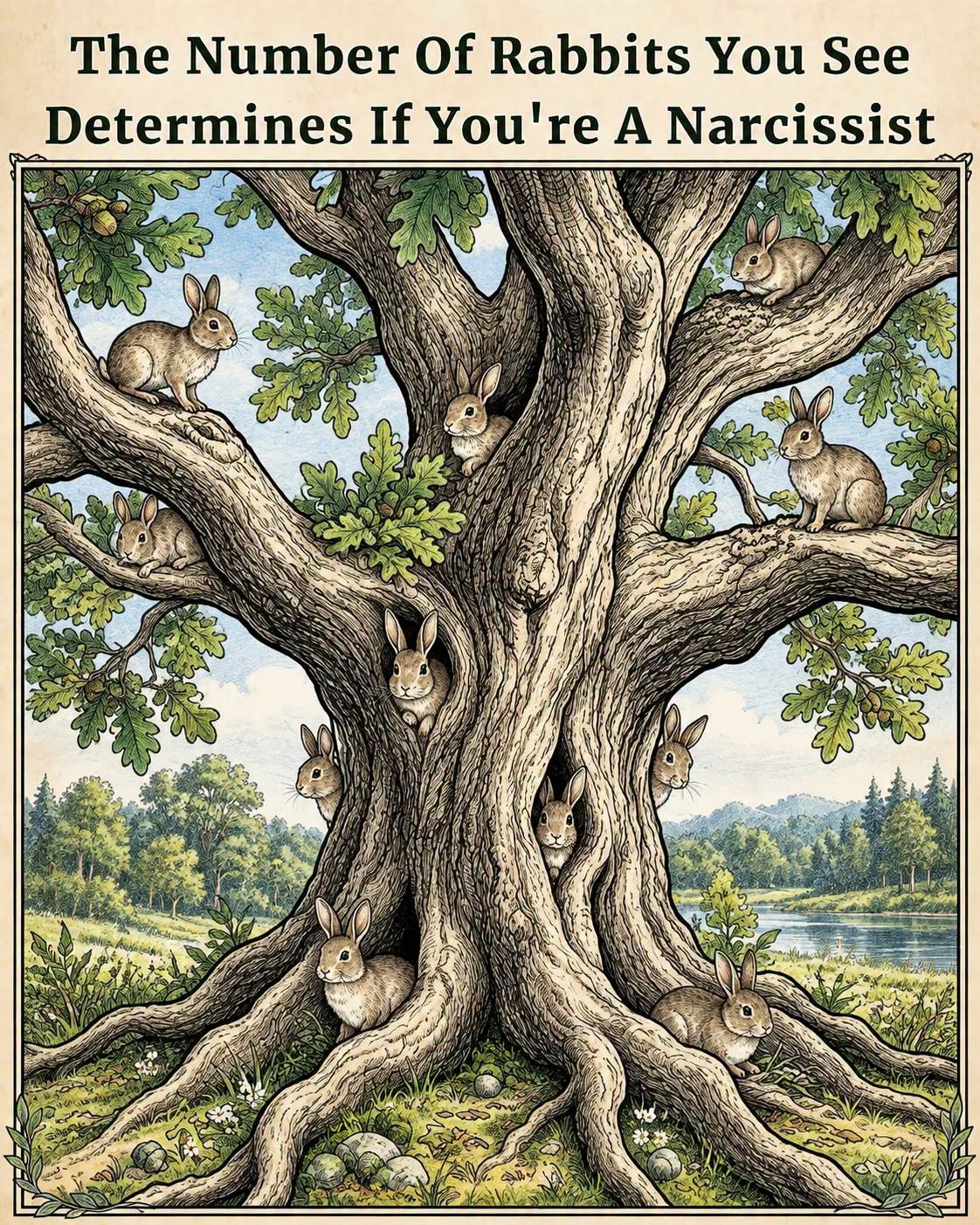
At first, there is only a tree.
A trunk.
Branches.
Leaves.
Maybe some shadows.
You glance at the picture and wonder why anyone thought it was interesting enough to turn into a puzzle.
Then you see the first rabbit.
And everything changes.
Suddenly, the tree isn’t just a tree anymore.
A curve that looked like bark becomes an ear.
A patch of empty space becomes a face.
Two branches form the outline of a body.
You find another rabbit.
Then another.
And now you can’t stop looking.
The image hasn’t changed.
Your brain has.
That’s what makes hidden-picture puzzles so satisfying. They transform an ordinary scene into a small argument between what is visible and what we initially notice.
Online, puzzles like this often arrive with dramatic promises.
“If you see only three rabbits, you’re impulsive.”
“If you find seven, you’re highly intelligent.”
“Spot all of them and you’re a genius.”
Sometimes the claims become even more extravagant.
Your rabbit count supposedly reveals whether you’re narcissistic, analytical, emotionally intelligent, unusually observant, or part of some tiny percentage of people with exceptional perception.
It’s entertaining.
It’s also not how personality assessment works.
A hidden-rabbit picture cannot diagnose narcissism.
It cannot calculate intelligence.
It cannot reveal your emotional maturity from the number of ears you find disguised as branches.
And failing to spot one doesn’t mean your brain is defective.
What the puzzle can reveal is much simpler—and, in some ways, more interesting.
It can show you how easily attention changes what you experience.
Consider the first glance.
Most people don’t approach an image expecting deception.
If you are shown a forest scene, your brain begins categorizing it efficiently.
Tree.
Leaves.
Ground.
Background.
Done.
That efficiency is useful.
Imagine having to consciously analyze every line, shadow, texture, and color every time you entered a room.
You would barely make it through the doorway.
The brain simplifies.
It decides what matters and allows enormous amounts of visual information to fade into the background.
Then someone says:
“There are rabbits hidden in this picture.”
Now the assignment changes.
You look again.
The tree remains identical, but your attention receives a new instruction.
Find ears.
Find eyes.
Find rounded bodies.
Look at negative space.
Question unusual curves.
Suddenly, rabbits appear in places you had already looked.
That’s the fascinating part.
You didn’t necessarily fail to see those lines before.
You failed to interpret them as rabbits.
Seeing and recognizing are not always the same thing.
Once you understand that, the puzzle becomes less about counting animals and more about watching your own perception operate.
Some people scan quickly.
They catch the most obvious shapes and feel ready to move on.
Others linger.
They divide the image into sections.
Top left.
Top right.
Center.
Roots.
Branches.
Background.
They search systematically.
Some people rotate the image mentally.
Others physically turn their phone.
Some focus on outlines.
Some notice negative space.
Some become convinced every suspicious bump must be another rabbit and start discovering imaginary animals the artist never intended.
That last group deserves recognition too.
There is such a thing as looking too hard.
Human brains are exceptionally good at finding patterns.
Sometimes so good that we discover patterns that aren’t actually there.
We see faces in clouds.
Animals in rock formations.
Expressions in electrical outlets.
Figures in shadows.
That’s not necessarily a flaw.
Pattern recognition is fundamental to how we navigate the world.
But it explains why two people can stare at the same hidden-object image and disagree passionately about whether a particular cluster of lines is definitely Rabbit Number Nine.
One person sees ears.
The other sees bark.
Neither reaction requires a personality diagnosis.
What may be worth noticing, however, is how you respond when your first interpretation is challenged.
Suppose you initially find four rabbits.
Someone tells you there are more.
What happens next?
Do you immediately assume they’re wrong?
Do you become curious?
Do you methodically search again?
Do you get frustrated because the missing rabbit feels like a personal failure?
Do you enjoy the hunt more once you know something remains hidden?
Those reactions can inspire self-reflection.
Not because the puzzle scientifically measures your personality, but because observing your own habits can be interesting.
There is a broader lesson hiding inside the tree.
First impressions are efficient.
They are also incomplete.
We do this with far more than pictures.
We meet someone who seems unfriendly.
Tree.
We learn later that they’re painfully shy.
Rabbit.
We encounter a problem and decide there is only one solution.
Tree.
Someone approaches it differently.
Rabbit.
We assume a person is successful because their life looks polished from a distance.
Then we learn what they are carrying privately.
Another rabbit.
Reality frequently contains information that our first interpretation filtered out.
That doesn’t mean first impressions are worthless.
Often they’re useful.
Sometimes they’re correct.
The lesson is simply that an initial reading should not always become a permanent verdict.
Look once.
Then, when something matters, look again.
The opposite lesson matters too.
Some people become so determined to find hidden meaning that they struggle to accept the obvious.
Every message has a secret implication.
Every silence means something.
Every facial expression becomes evidence.
Every coincidence becomes a pattern.
That’s not necessarily deeper perception.
Sometimes a tree really is just a tree.
Good observation requires both abilities:
Knowing when to look closer and knowing when to stop.
That balance is more valuable than any viral personality label attached to a rabbit puzzle.
There is another reason these images become irresistible.
The moment of recognition feels good.
You’ve probably experienced it.
You stare at an apparently meaningless collection of branches.
Nothing.
Nothing.
Nothing.
Then—
There.
The rabbit appears.
And once you’ve seen it, returning to the previous state is almost impossible.
You wonder how you missed something that now seems obvious.
That’s because recognition reorganizes the image.
The rabbit was hidden only until your brain discovered the correct interpretation.
Afterward, the same lines carry different meaning.
This is why showing someone the location of a hidden object can almost ruin the puzzle.
“Look beside the second branch.”
Immediately, they see it.
“I can’t unsee it now.”
Exactly.
Perception has memory.
And perhaps that’s the most beautiful part of the exercise.
Not the rabbit count.
Not whether you found six, eight, ten, or whatever number the creator claims is hidden there.
Not the dramatic caption promising to expose whether you’re secretly a narcissist.
The interesting moment is the transition.
Before.
After.
The instant something that was always present finally becomes visible to you.
Life contains versions of that moment everywhere.
You suddenly understand why an old relationship kept hurting.
Why a friend reacted the way they did.
Why a habit isn’t helping anymore.
Why a problem at work keeps repeating.
Why something you’ve been chasing doesn’t actually make you happy.
Nothing outside necessarily changes at the moment of realization.
The lines were already there.
What changes is the pattern you recognize.
That’s why a silly hidden-rabbit puzzle can become unexpectedly reflective if you let it.
Maybe you’re naturally a big-picture person.
Maybe details grab you first.
Maybe you trust your first impression.
Maybe you keep searching long after everyone else has moved on.
None of those tendencies automatically makes you wiser, kinder, smarter, or more difficult.
They’re simply different ways of directing attention.
And attention can be trained.
The fast scanner can learn to linger.
The obsessive searcher can learn to zoom out.
The person convinced they already know what they’re seeing can ask:
“What else could this be?”
So count the rabbits.
Compete with your friends.
Rotate the picture.
Zoom in until the pixels surrender.
Celebrate when you find the one everyone else missed.
Just don’t let a viral caption convince you that a cartoon animal hiding in tree bark has diagnosed your personality.
The puzzle cannot tell you who you are.
But the few seconds between your first glance and your second might tell you something worth remembering.
Sometimes we need to zoom out.
Sometimes we need to look closer.
And sometimes the most important things aren’t invisible at all.
We simply haven’t learned how to see them yet.