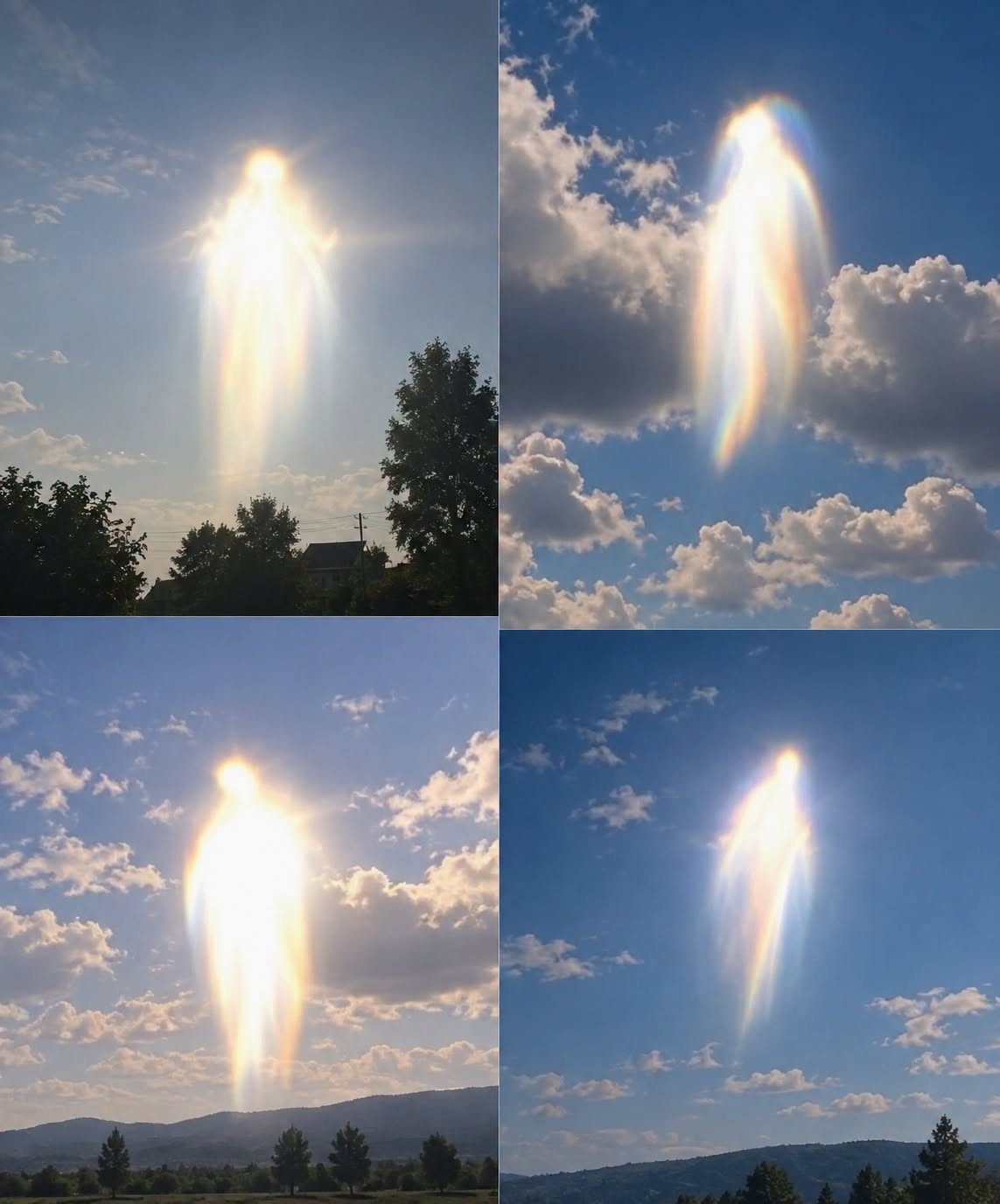
For a few extraordinary moments, the sky above Ikaria seemed to contain something that should not have been there.
A luminous shape hovered against the horizon.
It appeared suspended rather than falling, glowing rather than reflecting, and changing just enough to give the unsettling impression that it might be moving deliberately.
People looked up.
Phones came out.
The obvious question followed.
What is that?
To someone watching from the ground, “aircraft” or even “UFO” can feel more intuitive than the real explanation.
But the atmosphere is capable of producing scenes far stranger than most of us realize.
What appeared above the Greek island did not necessarily require a mysterious craft hiding among the clouds.
It required something much more ordinary.
Sunlight.
Air.
Water.
Temperature.
And the human brain.
Put those ingredients together under unusual conditions, and ordinary physics can create something that looks almost impossible.
The effect begins with light.
We tend to imagine sunlight traveling from the Sun to our eyes in perfectly straight lines.
Most of the time, treating it that way works well enough.
But Earth’s atmosphere isn’t uniform.
Light passes through layers of air with different temperatures, densities, moisture levels, particles, droplets, and sometimes ice crystals.
Each can influence what eventually reaches our eyes.
The effect becomes particularly dramatic near sunrise and sunset.
When the Sun sits low on the horizon, its light travels through much more atmosphere than when it is directly overhead.
That longer journey changes what we see.
Colors intensify.
Objects distort.
Shadows stretch.
Layers of haze become visible.
The familiar sky starts behaving unfamiliar.
Ice crystals can make the transformation even stranger.
When countless tiny crystals are suspended high in the atmosphere and oriented in particular ways, they can refract or reflect sunlight into spectacular optical displays.
Halos can surround the Sun.
Bright patches called sundogs may appear beside it.
Columns of light can seem to extend vertically above or below the Sun.
Under the right circumstances, these features can appear almost architectural.
A luminous pillar doesn’t look like “ice.”
It looks like an object.
A glowing patch doesn’t immediately suggest “refraction.”
It suggests something occupying space.
That difference matters because the human brain isn’t a physics laboratory.
It is an interpretation machine.
When we see an unfamiliar shape in the sky, we don’t begin by calculating temperature gradients and refractive indices.
We ask:
What object looks like that?
And once the brain begins treating a pattern of light as an object, something remarkable happens.
We start expecting object-like behavior from it.
If the glow changes, it seems to move.
If it brightens, it seems to approach.
If one edge disappears, it may seem to rotate.
If the shape stretches, we imagine the object changing orientation.
But sometimes there is no object behaving strangely.
The light itself is changing.
Over the sea, another atmospheric phenomenon can make things even more deceptive.
Mirages.
Most people hear “mirage” and imagine a thirsty traveler seeing imaginary water in a desert.
Real atmospheric mirages are much broader than that cliché.
They occur because light bends while traveling through layers of air at different temperatures.
Above a large body of water, the necessary temperature structures can sometimes become pronounced.
Warm air may sit above colder air near the surface, creating a temperature inversion.
Light traveling through those layers bends.
The result can be astonishing.
A distant ship may appear to float above the horizon.
A coastline can seem taller than it actually is.
Objects can become stretched, compressed, duplicated, stacked, or displaced.
Sometimes pieces of distant scenery appear where geometry tells us they shouldn’t be visible at all.
One particularly complex form, often called a Fata Morgana, can transform distant objects into rapidly shifting towers, platforms, walls, or fantastical silhouettes.
The object itself may be perfectly ordinary.
The atmosphere becomes the lens.
Imagine seeing a distant ship transformed this way.
You may not see “ship.”
You might see a dark geometric structure floating above the sea.
Now add intense sunlight, haze, changing air layers, distance, and a phone camera struggling with exposure.
Suddenly, “mysterious craft” doesn’t seem like an irrational first impression.
It is simply an incomplete one.
And that’s important.
Explaining an unusual sight doesn’t require mocking the people who witnessed it.
The experience can be genuinely uncanny.
Our visual systems evolved to interpret the world quickly.
Something moving?
Track it.
Something approaching?
Identify it.
Something behaving unlike the background?
Pay attention.
That instinct is useful when the thing we’re observing is a person, animal, vehicle, or falling object.
It becomes less reliable when the “thing” is actually an optical phenomenon produced by layers of atmosphere extending across enormous distances.
Our brains want boundaries.
Where does the object begin?
Where does it end?
What direction is it moving?
Atmospheric light may provide no stable answers.
Tiny changes in temperature, moisture, crystal orientation, viewing angle, or sunlight can alter the appearance from moment to moment.
The glow shimmers.
The edges shift.
The apparent object changes shape.
To our pattern-seeking minds, that variability can feel almost intentional.
It appears alive.
But “alive” is an interpretation.
The atmosphere doesn’t need intention to create motion.
Consider something as familiar as a sunset.
Nobody watches the sky turn orange and concludes that an enormous orange object has appeared behind the clouds.
We understand that we’re seeing light interacting with the atmosphere.
But make the phenomenon smaller, brighter, more isolated, or more geometrically unusual, and our intuition changes.
Now we want an object.
That is one reason mysterious sky sightings have fascinated humanity for centuries.
Long before airplanes or spacecraft existed, people reported strange lights, fiery shapes, unusual suns, glowing columns, and impossible objects in the heavens.
They interpreted them using the vocabulary available to them.
Omens.
Angels.
Celestial armies.
Divine signs.
Later generations reached for different explanations.
Secret aircraft.
Missiles.
Experimental technology.
Extraterrestrial spacecraft.
The vocabulary changes.
The sky keeps producing strange things.
Of course, saying atmospheric optics can explain many unusual sightings does not mean every unidentified object has the same explanation.
“Unidentified” should mean exactly that until sufficient evidence exists.
Sometimes the object eventually turns out to be an aircraft.
Sometimes a balloon.
A satellite.
A rocket launch.
A drone.
A planet.
A meteor.
A camera artifact.
And sometimes atmospheric optics.
The responsible approach isn’t to begin with the most exciting explanation or dismiss everything unusual automatically.
It is to ask what evidence best fits what was observed.
Where was the Sun?
What time was it?
What direction was the observer facing?
What were the weather conditions?
Were temperature inversions present?
Did multiple observers see the same thing?
Did its apparent movement correspond with clouds or changes in viewing angle?
What did photographs actually capture, and what might the camera itself have introduced?
Those questions aren’t attempts to make the mystery boring.
They are how mysteries become understandable.
And atmospheric explanations can be more beautiful than the conspiracy theories replacing them.
Think about what has to happen.
Light leaves the Sun roughly 150 million kilometers away.
It reaches Earth.
It enters a constantly shifting atmosphere.
It encounters particles, droplets, crystals, and layers of air at different temperatures.
It bends.
Reflects.
Scatters.
Refracts.
Then, after that entire journey, a tiny fraction of it reaches someone’s eyes on an island in the Aegean Sea.
For several seconds, the geometry becomes just right.
A shape appears where no solid object exists.
Someone looks up.
Their brain says:
Something is there.
In one sense, the brain is wrong.
In another, the experience is completely real.
The light is real.
The atmospheric conditions are real.
The image reaching the eye is real.
Only the interpretation is uncertain.
That distinction is worth remembering whenever the sky produces something that seems impossible.
We often treat “natural explanation” as though it means “ordinary.”
Nature has never made that promise.
Lightning is natural.
Auroras are natural.
Solar eclipses are natural.
Meteor showers are natural.
Sundogs, halos, light pillars, mirages, and distorted horizons are natural.
None of them has to look ordinary.
Sometimes understanding the physics doesn’t destroy the wonder.
It increases it.
Because then the mysterious glow over Ikaria becomes more than a question about what might have been flying through the sky.
It becomes a reminder that the atmosphere above us is not an empty window.
It is an enormous, moving optical system.
A lens made from air.
A prism made from ice.
A constantly changing boundary between sunlight and human perception.
No secret craft is required.
No hidden visitors.
No elaborate cover-up.
Just the right light, the right atmosphere, the right angle, and a human brain doing exactly what it evolved to do:
trying to turn uncertainty into something recognizable.
Perhaps that’s the most unsettling—and beautiful—part.
We spend so much time searching the universe for things that look alien.
Every once in a while, Earth reminds us that it is perfectly capable of looking alien all by itself.
Sometimes the strangest thing in the sky isn’t hiding behind the atmosphere.
It is the atmosphere.