There are photographs that document history, and then there are photographs that seem to become history.
For Marcy Borders, one image taken on September 11, 2001, would follow her for the rest of her life.
She was only 28 years old, a young mother working for Bank of America in the North Tower of the World Trade Center. When the first plane struck, she escaped the building and made it outside. Then the South Tower collapsed, sending an enormous cloud of pulverized debris through Lower Manhattan.
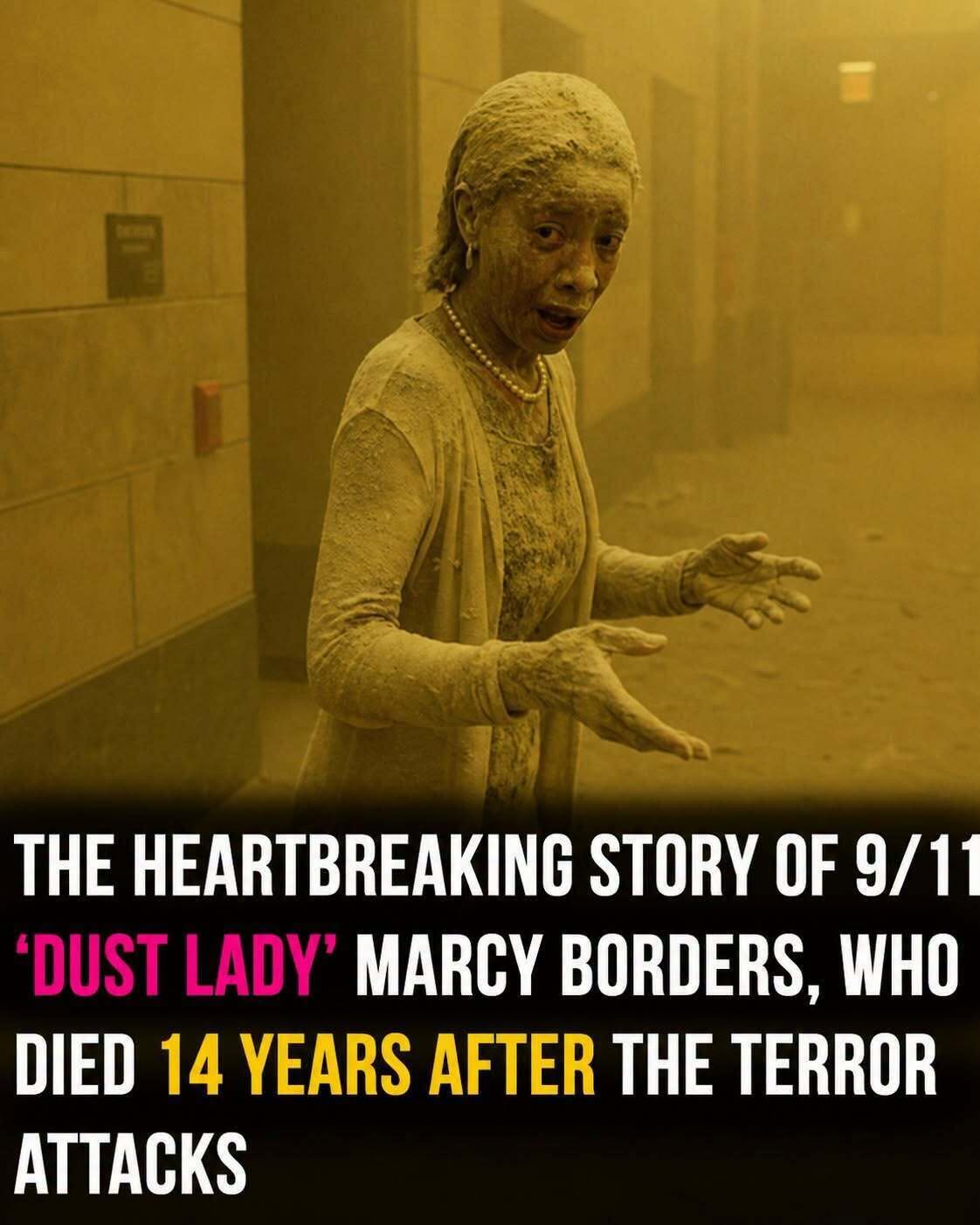
Photographer Stan Honda captured her after she had taken shelter nearby.
Marcy stood almost completely coated in pale gray dust. It covered her hair, face, clothing, eyelashes—nearly everything except the frightened expression still visible beneath it.
She looked less like someone posing for a photograph than someone who had just emerged from another world.
The image became known around the world.
Eventually, Marcy became widely known as the “Dust Lady.”
But there was something terribly incomplete about that name.
Because the world saw the dust.
Marcy had to live with everything underneath it.
In the years after the attacks, she spoke publicly about struggling profoundly with what she had experienced. The terror had not ended when she escaped Manhattan. It followed her home.
She described being frightened by airplanes. Tall buildings could trigger fear. News coverage and anniversary reminders could pull her emotionally back toward the morning she had survived.
That distinction matters.
Surviving a catastrophe physically does not mean walking away from it psychologically untouched.
The photograph had frozen Marcy in one instant, but her life kept moving.
And for a time, it moved into very dark places.
She struggled with depression and substance use, including crack cocaine. Her addiction damaged relationships and contributed to a period in which she lost custody of her children.
To strangers, she remained instantly recognizable as the woman covered in dust.
Inside her own life, she was fighting to remain standing.
There is a cruel contradiction in becoming a symbol of trauma. Millions of people may recognize your suffering while almost nobody understands what living inside that suffering actually feels like.
A photograph can show fear.
It cannot show the nightmare that comes months later.
It cannot photograph an addiction forming.
It cannot capture every morning when getting through another day feels harder than surviving the moment that made you famous.
Marcy’s story could easily be reduced to tragedy, but that would miss another important part of it.
She fought her way back.
Years after September 11, she entered rehabilitation and became sober. She rebuilt relationships with her children and began speaking more openly about what the attacks had done to her.
Recovery did not erase the photograph.
It changed what came after it.
Marcy was no longer merely the terrified young woman emerging from the dust. She was also a mother attempting to rebuild a life after trauma and addiction had nearly dismantled it.
For someone whose identity had been publicly attached to the worst morning of her life, recovery offered something the famous photograph never could:
a future.
Then, in 2014, another devastating chapter began.
Marcy was diagnosed with stomach cancer.
She was still only in her early forties.
Understandably, she wondered whether her illness was connected to the toxic cloud she had breathed on September 11. By then, concerns about long-term health consequences among survivors, residents, workers, and first responders had become impossible to ignore.
Thousands of people exposed to the World Trade Center disaster have since developed illnesses that are monitored or treated through federal programs, including numerous cancers and respiratory conditions.
But Marcy’s individual case requires care in how it is described.
Her belief that World Trade Center exposure caused her stomach cancer was deeply understandable, but that does not mean a direct causal link in her particular case was medically established. Cancer develops through complex combinations of factors, and determining what caused one person’s disease can be extremely difficult.
That uncertainty does not diminish the larger reality.
The health consequences associated with September 11 did not end when the smoke cleared.
They continued unfolding over years and decades.
Marcy Borders died from stomach cancer on August 24, 2015.
She was 42.
The woman who had survived one of the most photographed catastrophes in modern history was gone less than fourteen years later.
After her death, the famous image became harder to look at in the same way.
Originally, it had seemed to capture survival.
A woman had escaped.
She was alive.
She had made it out.
But knowing what followed changes the photograph.
Now it also raises questions about what survival actually demands from people after the cameras leave.
September 11 created many different kinds of victims.
There were those killed that morning.
There were families who waited for people who never returned.
There were first responders who entered burning buildings while everyone else was fleeing.
There were workers, residents, volunteers, cleanup crews, students, and survivors exposed to the enormous cloud that settled over Lower Manhattan.
And there were people like Marcy, whose wounds were both visible and invisible.
The long-term toll of World Trade Center-related disease has become an enduring part of the September 11 story. Thousands have died in the years since while many more continue receiving monitoring and treatment. Comparing that later toll with the number killed on September 11 itself requires careful definitions and reliable records, because different programs and organizations count populations and causes differently.
What does not require exaggeration is the central truth:
September 11 did not finish happening on September 11.
Its consequences continued in lungs, bodies, families, memories, courtrooms, hospitals, treatment centers, and ordinary homes.
That is why Marcy’s photograph remains so powerful.
Look closely at it and you see a young woman coated in the physical remains of catastrophe.
But history allows us to see what the camera could not.
She was a mother.
She struggled.
She became addicted.
She sought treatment.
She recovered.
She reunited with her children.
She became ill.
And at 42, she died.
Calling her the “Dust Lady” made the photograph easy to remember.
Remembering Marcy Borders requires more.
The dust was something that happened to her. It was never the entirety of who she was.
Perhaps that is the deeper responsibility carried by famous images of tragedy. They can preserve a moment, but they can also imprison a human being inside it if we forget that a life existed beyond the frame.
Marcy survived the morning that made the world recognize her.
Then came the much longer struggle to survive what that morning left behind.
Her photograph captured only a fraction of a second.
Her story is everything the photograph couldn’t show.