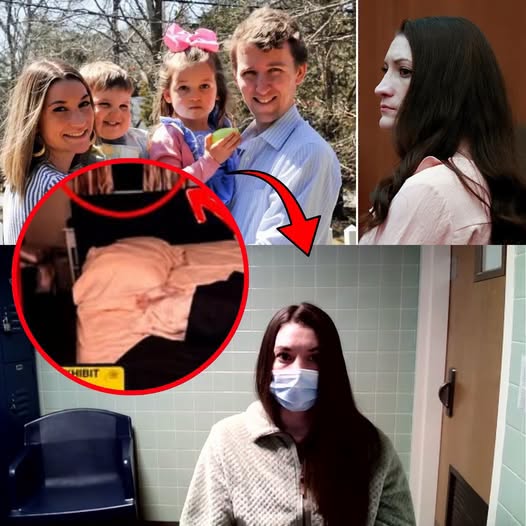
LEAKED DOCUMENT CLAIM: The Second-Floor Room, Alleged False Details and the Suicide Theory That Refuses to Disappear
A mysterious second-floor room.
A second bunk bed.
A disputed timeline.
And a camera angle that may not show what viewers first assumed.
Those are the elements now being woven together in a sensational claim about a case that has already generated intense speculation online.
According to an alleged document circulating on social media, investigators supposedly uncovered discrepancies involving the location of a second bunk bed, the timing of key events and details contained in an earlier account.
The claim suggests that those discrepancies could undermine a suicide scenario that had appeared to explain what happened.
But there is an important warning before the allegations are examined.
The purported leaked document has not been independently authenticated, and the specific claims about the second-floor room, a second bunk bed, false testimony or a disputed camera angle have not been established as verified facts.
There is also no reliable public evidence available confirming that investigators formally concluded that a suicide explanation had been disproved by such evidence.
Nevertheless, the allegations have spread rapidly because they focus on one of the most compelling questions in any investigation:
What if the physical scene does not match the story originally told about it?
THE ROOM AT THE CENTRE OF THE CLAIM
The alleged document reportedly focuses on a room located on the second floor.
At first glance, the detail may sound insignificant.
A room.
A bed.
A window.
A camera.
But in forensic reconstruction, seemingly ordinary details can become crucial.
Investigators reconstruct scenes by establishing where objects were located, where people could have stood, what could have been seen from particular positions and whether the timeline provided by witnesses is physically possible.
A bed cannot simply be moved on a diagram without consequence.
A window cannot provide a particular camera view if an obstruction blocks it.
And a person cannot be in two locations at the same time.
That is why the alleged discrepancy involving a second bunk bed has become one of the most intriguing elements of the circulating story.
The claim suggests that the physical position of the bed did not correspond with the description contained in an earlier account.
If independently verified, such a discrepancy could require investigators to revisit how the scene was reconstructed.
But there is currently no authenticated evidence proving that this discrepancy occurred.
THE TIMELINE PROBLEM
The second major element of the allegation is timing.
According to the claim, investigators supposedly compared the timeline described in an original account against the physical layout of the room and the footage available from a nearby camera.
The alleged result was a contradiction.
Something reportedly could not have happened in the precise sequence originally described.
This is where the story becomes particularly complicated.
A timeline in an investigation is not simply a list of times.
It can involve travel between rooms, opening and closing doors, changes in lighting, camera activation, phone activity and the position of people or objects.
Even a difference of a few minutes can sometimes become important.
But a discrepancy does not automatically mean that somebody lied.
Witnesses can misremember.
Clocks can be inaccurate.
Camera systems can use different timestamps.
Documents can contain transcription errors.
And investigators themselves may revise early assumptions as additional evidence becomes available.
That is why an alleged timeline contradiction would need to be examined alongside the original evidence before any conclusion could be reached.
IMAGE INSERT — FORENSIC SCENE RECONSTRUCTION
Suggested image: a non-identifying forensic reconstruction of a second-floor bedroom, bunk bed, window and CCTV camera angle. Do not imply that the image depicts the actual location involved in the case.
THE CAMERA ANGLE
Then there is the window.
The alleged document reportedly draws attention to the angle of a camera positioned near or facing the window.
This detail has become particularly significant in online discussions because cameras do not see an entire room.
They see a specific field of view.
A person standing outside the frame may be invisible.
An object positioned behind a bed may disappear from view.
A reflection can create confusion.
And the apparent direction of movement may look different depending on the camera’s height and position.
The claim suggests that the camera angle may have created an assumption about what happened inside or near the room.
But again, the public has not been presented with an authenticated forensic analysis establishing that conclusion.
A screenshot from a video is not enough.
Investigators would need the original footage, metadata, camera specifications, precise positioning and potentially a reconstruction of the room.
Only then could an expert determine what the camera could or could not have captured.
WAS THE ORIGINAL ACCOUNT WRONG?
This is perhaps the most explosive suggestion contained in the alleged document.
It reportedly raises questions about whether some details in an earlier testimony or account were inaccurate.
The word “false” has been used in online posts.
But there is an enormous difference between false information and an inaccurate recollection.
That distinction becomes particularly important in a courtroom.
A person can remember an event incorrectly without deliberately fabricating it.
Investigators therefore have to establish why a statement conflicts with physical evidence.
Was the person mistaken?
Was the scene misunderstood?
Was information omitted?
Was the timeline reconstructed incorrectly?
Or was someone deliberately attempting to mislead investigators?
The evidence — not the headline — would have to answer those questions.
THE SUICIDE THEORY
The alleged document is also being used online to challenge a suicide scenario.
This is where the story requires the greatest caution.
If an investigation initially considers suicide, investigators would normally examine the physical scene, medical evidence, digital evidence, witness accounts and other circumstances.
If evidence later contradicts that theory, the investigation may broaden.
But a contradiction involving a bunk bed or camera angle would not, by itself, prove homicide.
Likewise, a disputed timeline would not automatically identify another person responsible.
There must be evidence connecting the discrepancy to an alternative explanation.
That distinction has largely disappeared in the viral version of the story.
Online posts have transformed an alleged inconsistency into something much larger — a supposed hidden truth capable of overturning the entire case.
There is currently no verified public evidence supporting that leap.
THE SECOND BUNK BED
Why has the alleged second bunk bed become so important?
Because physical objects can provide investigators with something that testimony cannot: a fixed reference point.
If a witness says somebody stood beside a particular bed, investigators can examine whether that position was physically possible.
If a camera supposedly recorded an event, investigators can determine whether the bed would have blocked the view.
If a person allegedly moved from one part of the room to another, investigators can measure the distance and calculate whether the timeline makes sense.
The bed therefore becomes more than furniture.
It becomes part of the reconstruction.
But this only matters if the alleged location of the bed is itself confirmed.
And that is precisely what remains unclear.
The public has not been shown authenticated scene photographs, forensic diagrams or verified measurements demonstrating the alleged discrepancy.
THE DOCUMENT THAT HAS NOT BEEN VERIFIED
The phrase “leaked information” carries enormous weight online.
It suggests secrecy.
It suggests that somebody inside an investigation has revealed something that authorities do not want the public to see.
But leaked documents can take many forms.
Some are genuine.
Some are incomplete.
Some are old documents presented as new.
Others may be edited, misinterpreted or completely fabricated.
That is why investigators, journalists and courts generally require provenance.
Who created the document?
When was it created?
Who possessed it?
Was it altered?
Does it correspond with other evidence?
Can the information be independently confirmed?
Without those answers, the alleged document cannot safely be treated as an official investigative finding.
THE FATAL DISCREPANCY
Still, the central allegation remains striking.
A timeline.
A second-floor room.
A second bunk bed.
A camera pointed toward a window.
And an account that allegedly does not match the physical reality.
If those elements were all independently verified, investigators would have a legitimate reason to examine the scene again.
The question would no longer be simply what someone remembered.
It would become:
What actually happened inside that room?
That is the point where physical evidence can become more powerful than recollection.
A measurement cannot change its memory.
A fixed camera position cannot remember an event differently.
A room’s architecture remains what it is.
But even physical evidence requires interpretation.
A camera angle may show only part of an event.
A bed may have been moved.
A timeline may contain a simple error.
And an apparent contradiction may ultimately have an innocent explanation.
WHAT WOULD PROVE THE CLAIM?
For the alleged document to transform the case, investigators would need more than a dramatic description.
They would need the original CCTV footage.
They would need authenticated photographs of the second-floor room.
They would need the documented position of the bunk beds.
They would need reliable timestamps.
They would need the original witness statements.
And they would need expert analysis explaining precisely why those pieces of evidence contradict one another.
Only then could the alleged discrepancy be evaluated properly.
Until that evidence becomes available, the story remains unresolved.
THE QUESTION BEHIND THE WINDOW
Perhaps the most intriguing element is the camera.
What exactly could it see?
What could it not see?
Was the window within its field of view?
Could the second bunk bed have blocked part of the scene?
And did the recorded footage actually contradict the original account?
Those are legitimate forensic questions.
But they are questions — not answers.
The temptation in a sensational case is to fill the gaps with the most dramatic explanation.
A contradiction becomes a lie.
A strange camera angle becomes proof of staging.
A disputed suicide theory becomes evidence of murder.
A missing detail becomes a conspiracy.
Real investigations are rarely that simple.
THE STORY IS NOT OVER
The alleged document has therefore created more questions than it has answered.
If authentic, it could potentially prompt investigators to revisit the physical reconstruction of the second-floor room.
If the alleged timeline contradiction is real, investigators would need to understand why.
If the camera footage genuinely conflicts with testimony, the discrepancy would deserve examination.
But none of those possibilities establishes criminal responsibility on its own.
For now, the most important fact is that the alleged document and its explosive conclusions remain unverified.
The second-floor room remains at the centre of the speculation.
The second bunk bed remains a disputed detail.
The camera angle remains a question.
And the supposed contradiction between the original account and the physical scene remains unproven.
Yet one question continues to haunt the entire theory:
If the room really could not have looked the way the original account described it — who got the crucial detail wrong, and why?
Until the original evidence is examined and authenticated, that may be the most disturbing unanswered question of all.