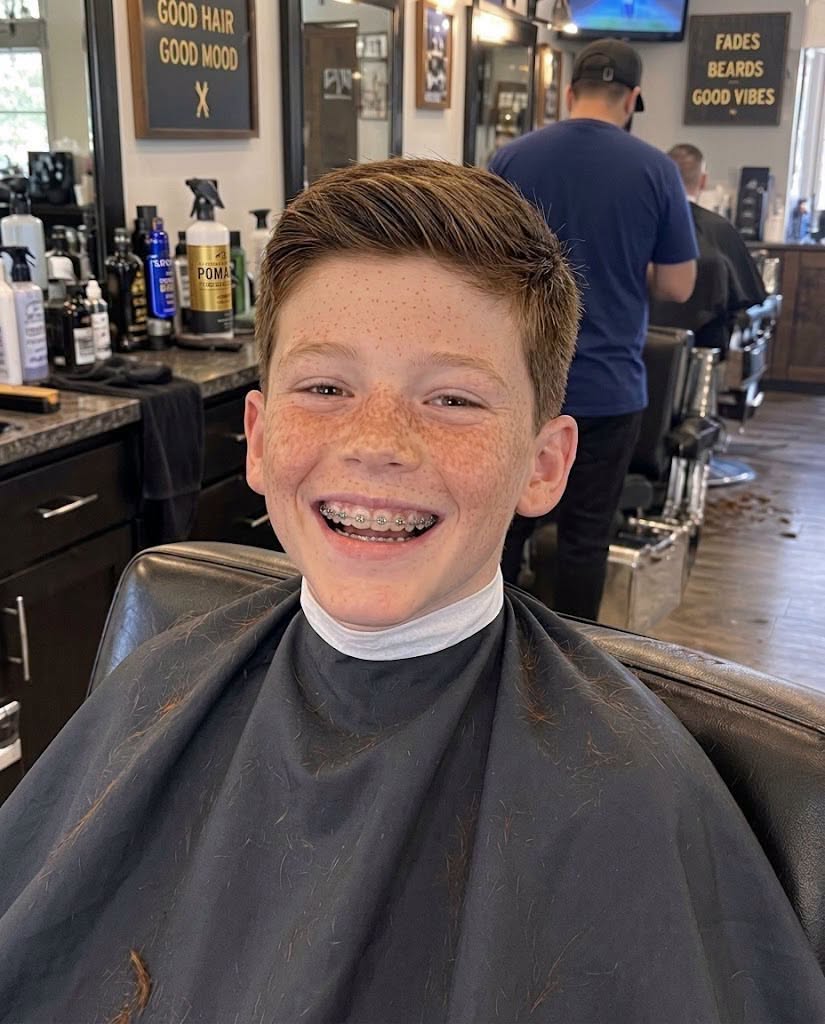
The barber had been cutting my nine-year-old son’s hair for fifteen minutes when the clippers suddenly went silent.
Marcus pulled Ethan’s hair away from his left ear and stared.
Then he looked at me through the mirror.
The easy smile he’d worn all morning was gone.
When the haircut ended, he waited until Ethan wandered toward the candy machine before leaning close.
“Check behind his left ear when you get home.”
“What did you see?”
“Something that shouldn’t be there.”
Twenty minutes later, two police cars were outside my house.
By the end of the week, I would learn that someone had discovered the most vulnerable part of my son—the grief he still carried for his dead father—and had been carefully using it against him.
It had started innocently.
At least, that was what Ethan believed.
After we got home, I moved his freshly trimmed hair aside and found a tiny flesh-colored patch tucked behind his ear.
Something hard rested beneath it.
I lifted the edge just enough to see a black disc.
“Ethan, who put this here?”
His cheerful expression vanished.
“I don’t know.”
“You’re not in trouble.”
He stared at the floor.
“Maybe the man from school.”
“What man?”
“The one who knew Dad.”
My blood went cold.
Ryan had been dead for three years.
I stopped touching the object and called police.
The dispatcher told me to leave it in place, lock the doors, and stay with Ethan.
When officers arrived, they didn’t guess what the object was. They preserved it and began asking questions.
That was when Ethan finally told me about the stranger.
The man had approached him several times near school.
He showed Ethan an old photograph of himself standing beside Ryan.
He knew things about my husband.
Real things.
Ryan’s favorite fishing spot.
The soccer team he’d helped coach.
The nickname he used for Ethan.
To a nine-year-old desperately afraid of forgetting his father, those details were irresistible.
Then Ethan pointed toward our coat closet.
“He gave me something.”
An officer stopped me from approaching.
“What?”
“A case. He told me to hide it.”
Police found a black case behind our winter boots.
That discovery changed the atmosphere immediately.
More investigators arrived. Ethan and I were moved away while the objects were documented and collected properly.
Then Ethan told them the stranger’s name.
“Uncle Derek.”
I felt physically sick.
Derek was Ryan’s older brother.
Ethan had been too young to recognize him.
I hadn’t seen Derek since before Ryan died, and there was a reason for that.
During Ryan’s final months, when illness had reduced my strong, energetic husband to someone who needed help crossing a room, he made me promise one thing.
“Keep Derek away from Ethan.”
I never knew the entire reason.
Ryan called it a family financial dispute.
Then he became sicker, and everything else seemed insignificant.
Now Derek was approaching our child in secret.
The investigation uncovered something even more disturbing.
A small camera had been concealed near our front entrance.
It appeared positioned to capture people entering and leaving.
Suddenly, Derek’s behavior no longer resembled an estranged uncle clumsily trying to reconnect.
There was planning behind it.
And Ethan knew more.
Derek had told him the black disc was a “secret key.”
He had instructed Ethan not to show it to me.
Especially me.
“He said you’d throw Dad’s things away,” Ethan whispered.
I dropped to my knees.
“I would never do that.”
“He said you didn’t want me knowing everything about Dad.”
That hurt because there was just enough truth inside the lie to make it believable.
I had avoided talking about Ryan sometimes.
Not because I wanted Ethan to forget him.
Because remembering him still hurt me.
Derek had noticed the empty space my silence created.
Then he stepped into it.
Investigators eventually determined that the disc corresponded to the secured case.
Inside were financial documents, copies of checks, transfer records, and digital material.
At first glance, they seemed devastating.
They suggested Ryan had diverted money from a business he once shared with Derek.
Then I noticed a date.
July 14.
“This isn’t possible.”
A detective looked at me.
“Why?”
“Ryan was hospitalized that entire month.”
I remembered July 14 precisely.
Ryan had been critically ill. He wasn’t conducting business transactions or quietly moving money around.
That inconsistency gave investigators something concrete to verify.
As the records were compared with originals, more problems emerged.
Dates conflicted.
Signatures required scrutiny.
Transactions didn’t align cleanly with legitimate records.
What had looked convincing at first began raising serious questions about fabrication.
Then investigators discovered the larger history.
Years earlier, Ryan had suspected Derek of financial misconduct involving their business and family money.
Ryan had kept records.
Derek apparently knew it.
And recently, I’d mentioned to one of Ryan’s relatives that Ethan wanted to visit the storage unit containing his father’s belongings.
That information had traveled.
Suddenly Ethan’s strange behavior over the previous month made sense.
“Can we visit Dad’s storage unit?”
“When?”
“Tomorrow?”
“No, buddy.”
“What about Saturday?”
He had asked repeatedly.
I thought grief was driving him.
Partly, it was.
But Derek had encouraged it.
“If she says no,” he’d told Ethan, “ask again tomorrow.”
The case was supposed to go with us.
Once inside the storage unit, Ethan had been instructed to place its contents among Ryan’s possessions.
“He said they belonged to Dad,” Ethan explained.
“He told you to hide them inside Dad’s boxes?”
Ethan nodded.
“He said I was putting them back.”
I had to leave the room for several minutes after hearing that.
The cruelty was breathtaking.
Derek hadn’t merely manipulated a child.
He had transformed Ethan’s love for his dead father into a delivery system.
If the plan worked, I might eventually discover suspicious documents among Ryan’s belongings and believe they had been there for years.
My own son would have unknowingly helped place them there.
And Derek had chosen Ethan because grief made him persuadable.
That realization destroyed whatever sympathy I might once have had for an estranged brother wanting contact with his nephew.
Investigators handled what came next.
There was no dramatic confrontation I needed to engineer.
Derek expected to see Ethan again near school.
Instead, law enforcement documented his appearance and dealt with him through the investigation.
I kept Ethan away.
My job wasn’t catching Derek.
It was protecting my son.
Several days later, Ethan asked me a question.
“Was Dad really mad at Uncle Derek?”
“Yes.”
“Why didn’t you tell me?”
I almost gave him the comfortable answer.
You were too young.
That was true.
It wasn’t the whole truth.
“Because talking about your dad hurt me.”
Ethan watched me.
“Sometimes I told myself I wasn’t talking about him because I didn’t want to make you sad.”
“Did it make you sad?”
“Yes.”
He thought about that.
“I’d rather be sad and know him.”
Those words changed me.
That weekend, I took Ethan to Ryan’s storage unit.
Not because Derek had wanted us there.
Because Ethan did.
We sat on the concrete floor opening boxes.
Ryan’s baseball glove.
His watch.
Concert tickets.
Fishing equipment.
A ridiculous yellow Christmas tie.
Then Ethan found a tiny hospital bracelet.
His own.
Beside it was another marked with Ryan’s name and the word FATHER.
“He kept mine?”
“He kept everything.”
Another box contained preschool Father’s Day cards.
One said:
MY DAD IS STRONG BECAUSE HE CAN OPEN JARS.
Ethan laughed until tears came.
Then he cried for real.
So did I.
For hours, I told him stories.
How Ryan had practiced holding a newborn using a bag of flour because he was terrified he’d drop Ethan.
How the bag split.
How Ryan blamed the imaginary baby.
How he once chased a raccoon off our porch wearing only socks and accidentally locked himself outside.
How he stayed awake all night the first time Ethan had a fever.
Near the bottom of an old file box, I found an envelope.
Inside were financial records.
Original documents Ryan had preserved from his dispute with Derek.
Across the envelope, in his handwriting, was a warning not to destroy the copies because Derek knew they existed.
I stared at those words for a long time.
Then I contacted investigators.
The papers didn’t magically resolve everything.
Evidence still had to be authenticated and compared with other records.
But Ryan had preserved information that could now be evaluated alongside the material Derek had apparently tried to introduce.
For three years, the truth had been sitting quietly in a storage unit.
Derek’s attempt to control that truth had helped bring attention directly back to it.
Weeks later, Ethan needed another haircut.
“Tony?” I asked.
“Marcus.”
So we returned.
Marcus grinned when Ethan climbed into his chair.
“Back already?”
Ethan pointed at his head.
“Check behind both ears this time.”
Marcus laughed.
“Both ears. Deal.”
Watching Ethan joke again almost made me cry.
Afterward, I thanked Marcus privately.
He shrugged.
“I saw something unusual, and Ethan looked scared when I noticed it.”
“You could’ve ignored it.”
“I figured I’d rather speak up and be wrong.”
That sentence stayed with me.
So did Ethan’s.
I’d rather be sad and know him.
For three years, I had misunderstood what my son needed.
I thought protecting him meant moving forward.
Don’t dwell.
Don’t reopen wounds.
Don’t make every happy day about the father he’d lost.
But Ethan wasn’t trying to live in Ryan’s shadow.
He was trying to keep his father’s face from fading.
And every time I refused to enter that sadness with him, I accidentally left a blank space.
Derek had found one of those spaces.
He filled it with photographs, stories, secrets, and just enough truth to make his lies believable.
I couldn’t change that.
But I could make sure Ethan never had to search for his father through strangers again.
Now, when he asks about Ryan, I answer.
When I know the story, I tell it.
When I don’t know, I say so.
Sometimes we watch old videos.
Sometimes Ethan laughs at his father’s clothes.
Sometimes he studies Ryan’s face without saying anything.
Sometimes we both cry.
Ryan is still gone.
Nothing fixes that.
But his memory no longer belongs to whoever appears with the right photograph and claims to know him better.
It belongs to Ethan.
It belongs to me.
To hospital bracelets and terrible ties.
To fishing rods and Father’s Day cards.
To stories told honestly, including the painful ones.
I cannot give my son his father back.
But I can give him something I once underestimated.
The truth about who his father was.
Enough truth that grief doesn’t have to become an empty room waiting for someone else to walk into it.