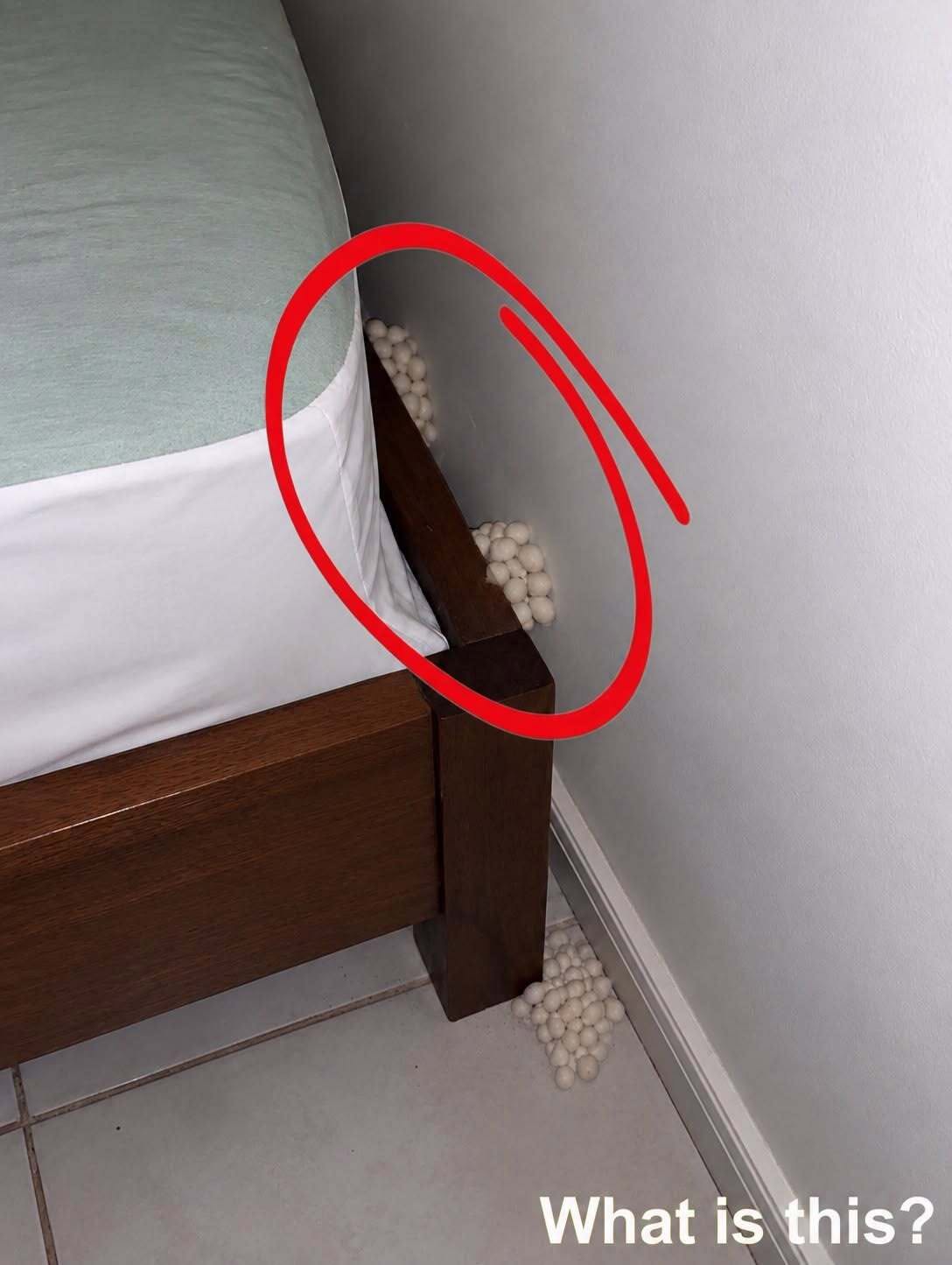
I came home wanting only one thing: rest.
It had been the kind of day that leaves you craving the familiar—the comfort of your own room, your own bed, the ordinary objects exactly where you left them. I dropped my things, kicked off my shoes, and was already imagining the relief of doing absolutely nothing.
Then I saw them.
Two small, pale ovals on the carpet.
I stopped.
They were tiny enough that I could easily have missed them, but once I noticed them, they seemed to dominate the entire room.
My first thought wasn’t curiosity.
It was panic.
What are those?
I leaned closer without touching them.
Eggs.
At least, they looked like eggs.
And that single realization was enough for my imagination to sprint ahead of reality.
Eggs meant something had laid them.
Something had been inside my room.
Something might still be inside my room.
Suddenly, the place where I had expected to relax no longer felt entirely mine.
I looked under the bed.
Nothing.
Behind the curtains.
Nothing.
Along the wall.
Nothing.
That should have reassured me.
Instead, it made things worse.
Because now whatever creature my imagination had invented was hiding.
I took out my phone and photographed the objects from several angles. Then I zoomed in until two harmless-looking white ovals became enormous shapes on my screen.
That was my next mistake.
I searched online.
“Small white eggs found indoors.”
The internet responded with approximately seventeen thousand reasons to abandon my home forever.
Insects.
Reptiles.
Pests.
Infestations.
Photographs of things I immediately regretted seeing.
I refined the search.
“Two small white eggs bedroom floor.”
More possibilities appeared.
Every image looked close enough to frighten me and different enough to provide no answer.
Within minutes, I had transformed uncertainty into catastrophe.
Maybe there were hundreds more.
Maybe they were inside the walls.
Maybe something had made a nest beneath my bed.
Maybe I needed pest control.
Maybe I needed to wash everything.
Maybe I should burn the house down.
That last thought was mostly a joke.
Mostly.
The strange thing was that nothing had actually happened.
I had found two tiny objects.
That was the complete collection of evidence.
Everything else—the infestation, the hidden creatures, the invasion—had been supplied by my own mind.
Fear is remarkably talented at filling empty spaces.
Give it one unanswered question and it can construct an entire horror story.
I kept searching.
Eventually, after comparing photographs, reading descriptions, and paying closer attention to their shape and appearance, I found an explanation that fit far better than the nightmares I’d been inventing.
They appeared to be gecko eggs.
I stared at the screen.
Then at the carpet.
Then back at the screen.
Gecko eggs?
The terrifying invasion inside my bedroom suddenly became something entirely different.
Somewhere nearby, a little gecko had apparently found what it considered a safe place.
That realization changed the emotional temperature of the room almost instantly.
I had been imagining menace.
What I was looking at was fragile life.
Geckos and other small lizards sometimes choose protected spaces for their eggs—quiet corners where the eggs can remain relatively undisturbed. Depending on the species, eggs may be small, pale, and firm-shelled, and sheltered areas around human structures can sometimes provide the conditions these animals seek.
My bedroom had not been invaded in the dramatic sense my imagination preferred.
To a gecko, it had probably just looked safe.
There was something almost funny about that.
I had walked into the room thinking, “Something got in here.”
The gecko, presumably, had entered thinking, “Finally, somewhere secure.”
Same room.
Completely different story.
I crouched beside the eggs again.
This time, I wasn’t afraid.
I was fascinated.
They looked even smaller now.
Not physically, of course.
Fear had simply stopped magnifying them.
That may have been the most surprising part of the experience.
Nothing about the objects had changed.
Only my understanding had.
Minutes earlier, they represented contamination and danger.
Now they represented vulnerability.
They were delicate little beginnings sitting quietly in a world enormous compared with whatever might eventually emerge from them.
I wanted to move them somewhere safer outside, but that presented another lesson: wildlife isn’t always as simple as picking something up and relocating it.
Reptile eggs can be delicate, and with some species, changing an egg’s orientation after development has begun may harm the embryo. So rather than casually shaking or rotating unfamiliar eggs, the sensible approach is to identify them as confidently as possible and, when necessary, seek advice from a local wildlife professional or knowledgeable reptile expert before disturbing them.
In my case, I treated them with extraordinary gentleness.
The person who had recently considered them evidence of an invasion was now behaving as though she had been entrusted with porcelain.
I carefully moved them to a protected place outside, trying to preserve their orientation and keep them sheltered rather than simply tossing them into the garden.
Then I stood there for a moment.
I felt ridiculous.
But also strangely moved.
I had begun the evening wanting to remove something frightening from my room.
I ended it hoping something tiny would survive.
That emotional reversal stayed with me.
The experience wasn’t really about geckos.
It was about uncertainty.
Human beings don’t like unanswered questions.
When we don’t understand something, the mind rarely leaves the blank space empty.
It fills it.
And if we’re already tired, anxious, or startled, what fills that space is often the worst possibility.
A noise downstairs becomes an intruder.
A harmless mark on the skin becomes a terrifying diagnosis.
A delayed message becomes rejection.
Two little eggs become an infestation.
Information doesn’t always eliminate legitimate danger, of course. Sometimes investigation reveals that caution really is necessary.
But fear should not be mistaken for evidence.
That night, mine had been almost entirely constructed from imagination.
The more I searched without understanding what I was seeing, the more frightened I became.
I wasn’t gathering information anymore.
I was gathering reasons to panic.
Once I had a plausible explanation, the same room looked different.
My bed was still my bed.
The carpet was still the carpet.
The shadows in the corners stopped looking suspicious.
Nothing had become safer in those few minutes.
I had simply stopped treating everything unknown as automatically threatening.
There was also something humbling about realizing that my private human space wasn’t quite as separate from nature as I imagined.
We build walls and doors and windows and tell ourselves:
Inside is ours.
Outside belongs to everything else.
Nature doesn’t necessarily recognize that arrangement.
Ants cross windowsills.
Spiders occupy corners.
Birds investigate roofs.
Geckos slip through openings and discover quiet spaces.
Sometimes coexistence is inconvenient.
Sometimes intervention is necessary.
And sometimes nature simply leaves two tiny reminders on the carpet that the world is much larger than the boundaries of a bedroom.
Later that night, lying in bed, I kept thinking about how quickly my story had changed.
First:
Something invaded my room.
Then:
Something chose my room because it seemed safe.
Those sentences describe almost the same event.
But emotionally, they belong to different worlds.
One made me frightened.
The other made me protective.
The difference was understanding.
I never expected two pale eggs on a carpet to teach me anything.
But they did.
They reminded me that fear loves unanswered questions and that imagination can turn uncertainty into danger long before the facts arrive.
Sometimes caution is necessary.
Sometimes the unknown really does deserve distance and professional help.
But sometimes what frightens us is simply something we haven’t understood yet.
I had come home believing my safe place had been violated.
Instead, for a brief moment, another living creature had apparently decided it was safe too.
By the time I turned off the light, I no longer felt invaded.
I felt strangely honored.
Nature had slipped quietly into my ordinary evening, left behind something fragile, and disappeared before I understood what had happened.
The eggs hadn’t changed.
My eyes had.
And I fell asleep thinking that perhaps the unknown isn’t always something waiting to frighten us.
Sometimes it is simply life, quietly asking us to look a little closer before we decide what we’re seeing.