Paul had expected the DNA test to answer a question.
Instead, it erased the ground beneath his family.
The first result was confusing enough.
Austin was not his biological son.
Paul read the report twice, then a third time, searching for some technical phrase that might make the conclusion less absolute.
It didn’t.
For nearly two decades, Austin had called him Dad.
Paul had held him through fevers, taught him to ride a bicycle, sat through school performances, corrected homework, bandaged scraped knees, argued about curfews, and waited up when Austin was late.
Now a laboratory was telling him they shared no biological connection.
There seemed to be one obvious explanation.
And it threatened to destroy his marriage.
Paul’s wife stared at him when he showed her the result.
“No.”
That was all she said at first.
Then again:
“No.”
Paul didn’t accuse her immediately, but the question existed between them.
She saw it.
“You think I cheated on you?”
“I don’t know what to think.”
“Austin is your son.”
“The test says he isn’t.”
“Then the test is wrong.”
She insisted there had never been another man.
Not before Austin’s birth.
Not around the time he was conceived.
Not secretly.
Not once.
Paul wanted to believe her.
But DNA didn’t care what anyone wanted.
So they tested again.
The result remained the same.
Paul was not Austin’s biological father.
Then his wife made a decision that should have ended the mystery.
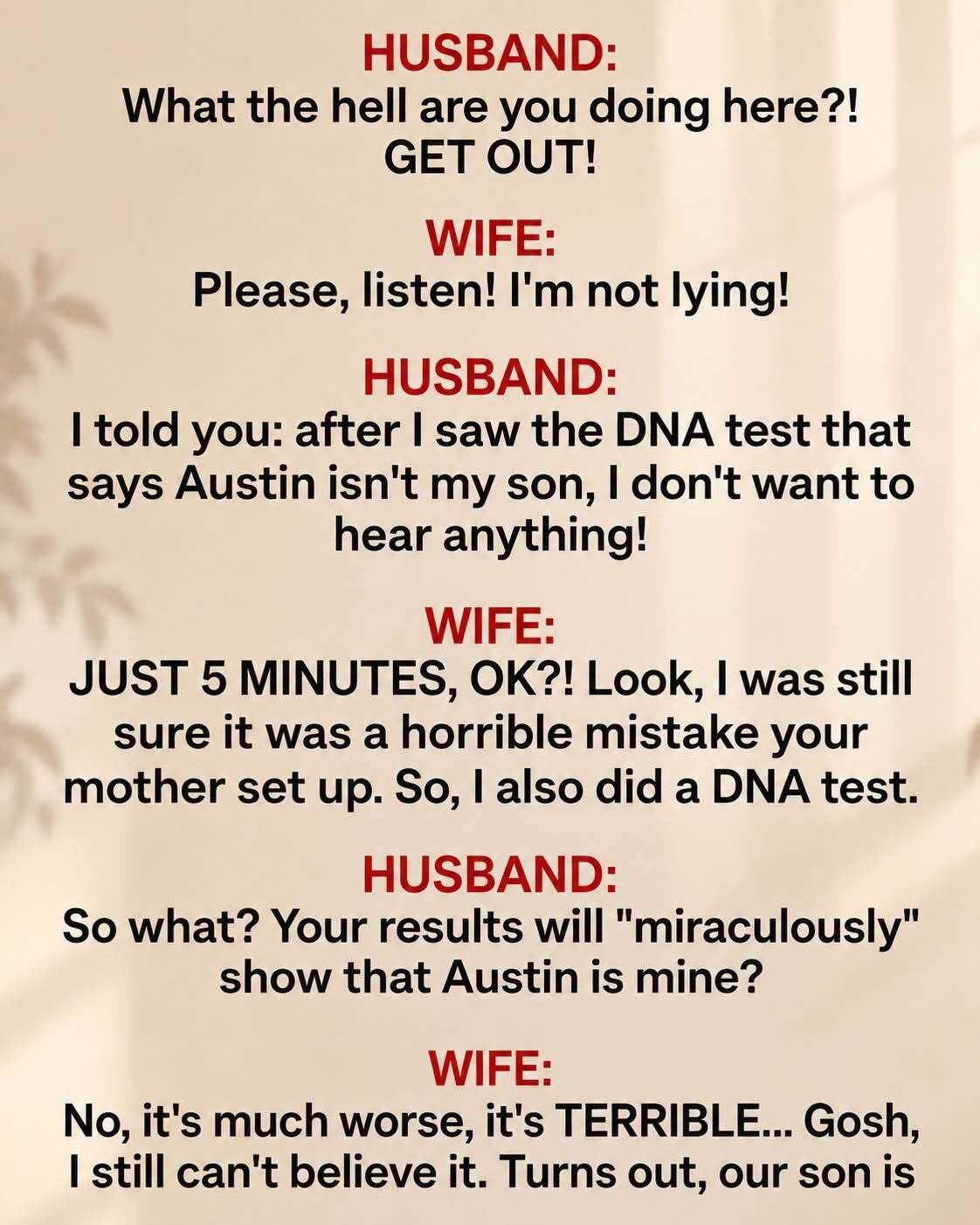
“Test me.”
Paul looked at her.
“What?”
“If there’s some mistake, test me too.”
There was no fear in her voice now.
Only anger.
She knew she had given birth to Austin.
She remembered the contractions, the hospital room, the exhaustion, the nurse placing a baby near her.
A DNA test could question Paul.
It couldn’t question that.
Except it did.
When the results arrived, neither of them understood what they were reading.
Austin wasn’t biologically related to her either.
This time there was no accusation available.
No affair could explain it.
No secret.
No betrayal between husband and wife.
Paul sat at the kitchen table with the papers spread in front of him.
His wife whispered, “That’s impossible.”
And logically, it seemed to be.
She had given birth.
They had taken their baby home.
They had raised him.
Yet the young man sleeping down the hall apparently belonged biologically to neither of them.
The investigation led backward.
Back through years.
Back through paperwork.
Back to the maternity ward where their family had begun.
Dates were checked.
Hospital records were requested.
Memories they hadn’t revisited in years suddenly became evidence.
Which nurse had brought the baby?
How long had he been away from the room?
Were there other newborn boys in the nursery?
Had identification bands been checked?
Could records have been mixed up?
The questions became increasingly unbearable because one possibility slowly began making sense.
Austin had not been switched on a document.
He had been switched as a baby.
Another family had left that hospital carrying Paul and his wife’s biological son.
And Paul and his wife had left carrying theirs.
Two babies.
Two homes.
Two childhoods.
One mistake.
When the other family was eventually identified and contacted, disbelief began all over again.
They had a son too.
He had grown up believing the people who raised him were his biological parents.
He had birthday photographs.
Christmas traditions.
A bedroom.
Favorite meals.
Family jokes.
A childhood history as real as Austin’s.
Then DNA confirmed what nobody wanted confirmed.
The boys had been exchanged.
Paul finally understood why the truth felt so much larger than a medical error.
A mistake in a hospital had continued living for years.
Every birthday it remained undiscovered.
Every family photograph preserved it.
Every time one boy said “Mom” or “Dad,” the error became more deeply woven into a real relationship.
And now biology had arrived years late, demanding to be acknowledged.
Meeting his biological son was one of the strangest moments of Paul’s life.
He had imagined it repeatedly beforehand.
Would he recognize him instantly?
Would he feel some mysterious parental connection?
Would the boy resemble him?
His wife?
A grandparent?
Then the young man entered the room.
Paul’s breath caught.
There were familiar features.
A shape around the eyes.
A particular expression.
Something in the face that made biology suddenly visible.
But recognition came with grief.
Here was his son.
And also, in every practical sense, a stranger.
Paul didn’t know his favorite childhood cartoon.
He hadn’t taught him to swim.
He didn’t know what frightened him at six.
He hadn’t attended his first day of school.
He hadn’t been there for the illnesses, arguments, victories, disappointments, or ordinary Tuesday nights that turn parenthood from biology into history.
Another man had.
That realization could have created resentment.
Instead, it produced something more complicated.
Gratitude mixed with loss.
The other father had raised Paul’s biological child.
Paul had raised his.
Neither man had stolen anything.
Neither mother had chosen the arrangement.
All four parents had simply loved the baby they were handed.
Then came the question everyone feared.
What happens now?
On paper, biology appeared to offer a clean answer.
Return children to biological families.
But families aren’t packages delivered to the wrong address.
Years cannot be returned.
Attachment cannot be reassigned by laboratory report.
Austin wasn’t an infant anymore.
He knew who his parents were.
He knew which voice had comforted him after nightmares.
Which parent became strict when grades slipped.
Who made breakfast.
Who embarrassed him.
Who forgave him.
Who had been there.
The other boy had those bonds too.
To suddenly declare that none of it counted because DNA revealed a different origin would create another injury in the name of correcting the first.
So the families chose something harder.
They did not exchange sons.
They expanded the meaning of family.
Austin remained Paul and his wife’s son.
Not biologically.
But completely.
Their biological child remained with the parents who had raised him.
Then, cautiously, everyone began building relationships that should have started years earlier.
There were awkward conversations.
Shared meals.
Photographs.
Questions about medical history.
Stories exchanged from childhoods the biological parents had missed.
Sometimes similarities were funny.
A gesture.
A food preference.
A laugh.
Sometimes they hurt.
Paul might hear about his biological son’s first bicycle and realize another father had been running behind it.
His wife could look at an old school picture and grieve a first day she had never witnessed.
The other parents experienced the same thing when they learned about Austin.
There was no villain sitting across the table.
Only people mourning different versions of the same lost life.
That may have been what allowed them to move forward.
Nobody needed to compete over who was the “real” parent.
Biology was real.
So was upbringing.
The mistake didn’t make either form of connection imaginary.
Austin’s DNA could identify where he came from.
It couldn’t erase where he had been.
A laboratory could establish that Paul hadn’t contributed half his chromosomes.
It couldn’t delete the night Paul stayed awake beside his bed during a fever.
It couldn’t erase the first time Austin called him Dad.
It couldn’t remove birthdays, school plays, arguments, vacations, disappointments, inside jokes, or whispered apologies after fights.
Those things had happened.
They were not genetically inherited.
They were lived.
The biological son presented a different truth.
Blood mattered too.
Seeing yourself reflected unexpectedly in another human being can be powerful. Learning where certain features or family medical histories came from can matter deeply.
The families didn’t have to pretend biology was meaningless in order to honor the relationships already built.
That was the balance they eventually learned to hold.
Two truths.
These were their biological sons.
And these were their sons.
No laboratory result required one truth to destroy the other.
Over time, the catastrophe that had initially seemed capable of splitting two families began connecting them in a strange new shape.
There would always be grief.
No amount of love could restore the missing years.
Paul would never hold his biological son as a newborn.
His wife would never hear his first word.
The other parents would never experience Austin’s childhood firsthand.
That loss was permanent.
But they could refuse to create another permanent loss.
They could stop asking which family was legitimate and begin asking how much love there was room for now.
Years earlier, someone in a maternity ward had made a terrible mistake.
Two infants went through the wrong doors.
But everything that followed wasn’t a mistake.
The bedtime stories were real.
The scraped knees were real.
The birthday cakes were real.
The worry was real.
The sacrifices were real.
The love was real.
DNA eventually revealed which child had been born to which parents.
It could never determine who had become family.
That answer had already been written over thousands of ordinary days.
Not in blood.
In presence.