The hardest part is often the waiting.
Not the moment you first notice something wrong, because that moment is pure reaction.
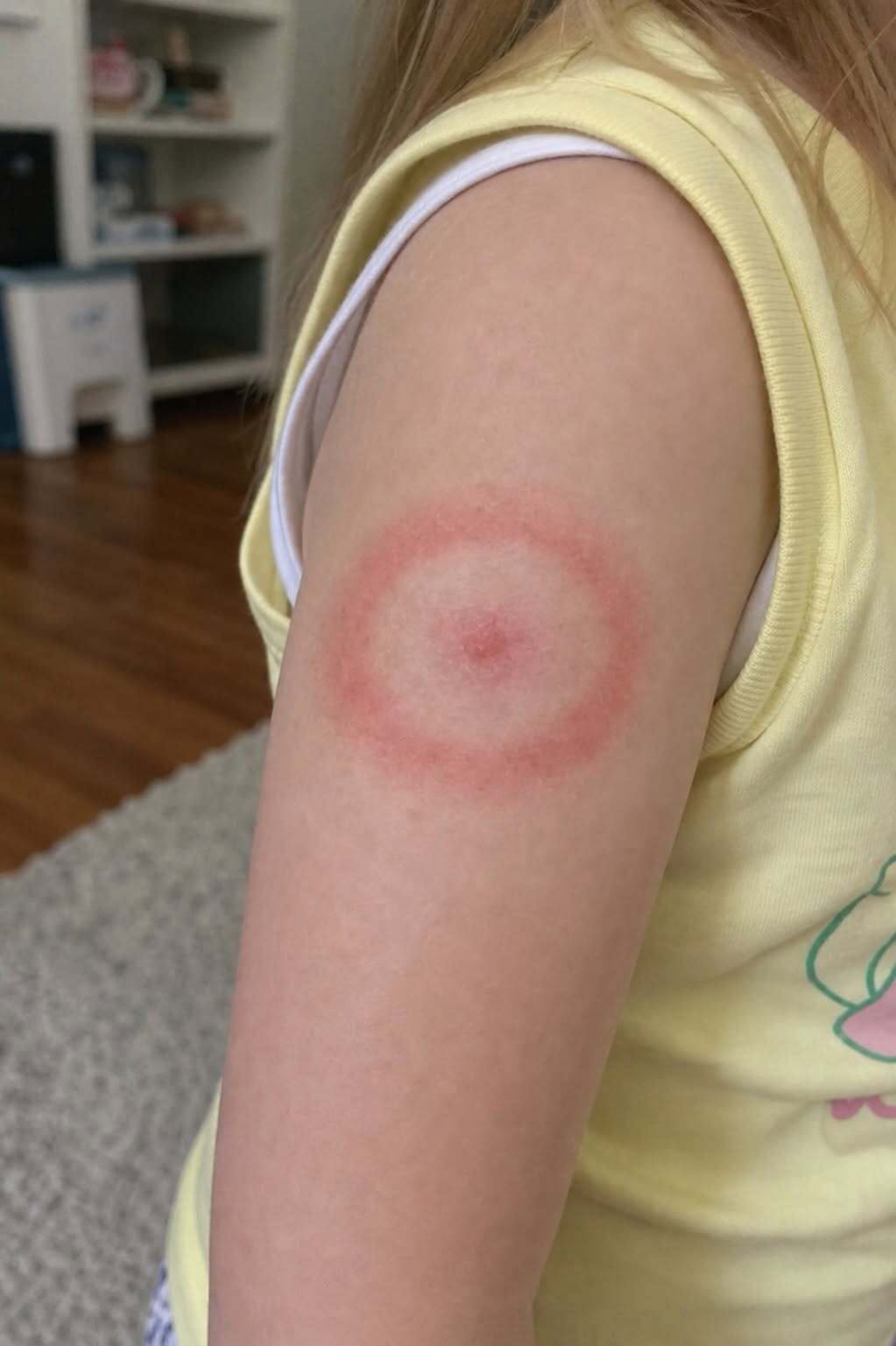
Your child comes running to you with a strange red patch on an arm or leg. Maybe there is swelling around what looks like a bite. Maybe the skin feels warmer than the surrounding area. Maybe neither of you knows exactly when it appeared.
For one terrible second, your mind goes everywhere at once.
Spider.
Tick.
Allergic reaction.
Infection.
Something poisonous.
Something you should have noticed sooner.
Fear is remarkably efficient at turning uncertainty into catastrophe.
You crouch beside your child and examine the spot again.
“Does it hurt?”
“A little.”
“Does it itch?”
“Kind of.”
“Do you feel sick?”
“No.”
Your child answers casually, already distracted by something across the room.
You are not distracted.
You are studying every millimeter of skin as though the answer might reveal itself if you stare hard enough.
This is where parenting can become strangely lonely.
Your child may be laughing five minutes later while you are silently imagining an emergency room.
You want certainty.
Instead, you have a red patch.
So you reach for something more useful than panic.
Observation.
You take a photograph.
You note the time.
You pay attention to whether the area seems to be expanding, becoming more painful, developing significant swelling, changing color, or producing drainage.
Depending on the situation and professional guidance, you might make a small mark at the visible edge of redness so that you can tell whether it spreads beyond that point. A pen line isn’t a diagnosis, and it should never become a reason to delay care when a child appears seriously ill.
It is simply information.
Still, in that moment, information feels powerful.
You write the time beside the line.
6:40 p.m.
Suddenly you have a reference point.
At 6:40, the redness ended here.
At 7:15, you look again.
Your child is on the floor playing.
You compare the skin with the photograph.
Maybe it looks unchanged.
Maybe you aren’t sure.
That uncertainty is maddening.
You check temperature.
Ask again about pain.
Watch breathing.
Notice energy.
Offer water.
Then comes the most difficult task of all.
You try not to examine the spot every thirty seconds.
Because monitoring can quietly become panic wearing a responsible disguise.
There is a difference between paying attention and becoming trapped by attention.
You remind yourself that a child’s overall condition matters.
Are they alert?
Breathing normally?
Drinking?
Behaving roughly like themselves?
Or are they becoming unusually sleepy, confused, weak, feverish, increasingly distressed, or difficult to wake?
Is there facial or tongue swelling?
Trouble breathing?
Repeated vomiting?
A rapidly spreading rash?
Severe or escalating pain?
Red or purple spots that don’t fade when pressed?
Those kinds of changes can demand urgent medical attention rather than another photograph and another hour of waiting.
You know this.
But knowledge doesn’t eliminate fear.
It gives fear boundaries.
That evening, your phone becomes a tiny medical record.
6:40.
7:20.
8:05.
Three photographs.
A few notes.
No dramatic conclusions.
Just evidence of what actually happened instead of what your frightened imagination insists might happen.
And something changes in you.
You stop asking yourself to predict the future.
You start paying attention to the present.
Your child laughs from the couch.
You listen.
Your child asks for a snack.
You notice.
Your child complains that you’re “looking at it again.”
You almost smile.
“Sorry.”
“You said that five minutes ago.”
“I know.”
“You’re weird.”
“Occupational hazard.”
“What occupation?”
“Being your parent.”
That earns an eye roll.
And somehow the eye roll helps.
Because your child is still here, still themselves, while your mind has spent the last hour visiting disasters that have not happened.
That doesn’t mean you ignore the skin change.
It means you refuse to confuse vigilance with certainty.
Sometimes the right decision will be to contact a pediatrician, urgent care service, poison center, or other appropriate professional and describe what you are seeing.
Sometimes they may want photographs.
Sometimes they’ll tell you what changes should trigger an examination.
Sometimes they may recommend being seen immediately.
And if your instincts are telling you that your child is significantly unwell, you do not need to wait for the situation to become dramatic enough to satisfy some imaginary threshold.
Seeking help is not overreacting simply because the eventual explanation turns out to be minor.
At the same time, not every mysterious mark is an emergency.
Parenthood requires living inside that uncomfortable truth.
You are constantly making decisions with incomplete information.
Is this fever ordinary or concerning?
Is that cough improving?
Did the fall hurt more than your child admits?
Is this rash spreading?
Should we wait?
Should we call?
Should we go now?
There is no magical instinct that answers every question correctly.
Good parenting is not omniscience.
It is attention combined with judgment.
It is knowing when observation is appropriate and when observation has reached its limit.
Hours later, you examine the line again.
Perhaps the redness has stayed inside it.
Your child’s temperature remains normal.
They are drinking, talking, complaining about bedtime.
Relief arrives cautiously.
Not triumphantly.
You know that symptoms can change and that you’ll continue watching as appropriate.
But your shoulders finally drop.
Or perhaps you discover the opposite.
The redness has moved beyond the mark.
The pain is worse.
Your child no longer seems like themselves.
Then the line has done something useful.
It has shown change.
You gather your photographs and notes and seek medical care.
Now, instead of trying to reconstruct everything from memory while frightened, you can say:
“This is what it looked like at 6:40.”
“This was an hour later.”
“This is when the pain increased.”
“This is what changed.”
Those details may help a clinician understand the progression, though the examination and medical history remain far more important than any homemade tracking system.
Either way, you have learned something about courage.
It does not always look like rushing dramatically into action.
Sometimes courage means slowing down enough to notice.
Sometimes it means making the phone call.
Sometimes it means driving to the emergency department.
Sometimes it means accepting professional reassurance and going home.
And sometimes it means admitting that you simply don’t know.
Parents are often told to “trust your instincts,” but instinct is not a substitute for medical evaluation.
Fear can exaggerate.
Familiarity can minimize.
Both can mislead.
The better goal is not perfect intuition.
It is responsive attention.
Notice.
Document when useful.
Ask questions.
Seek qualified help when needed.
Escalate quickly when serious warning signs appear.
And don’t punish yourself for not knowing the diagnosis before the professionals do.
Later, after the danger has passed—or after the doctor has explained what you’re dealing with—you may look at that little ink line and realize why it mattered so much.
It never controlled what was happening beneath your child’s skin.
It controlled something smaller.
You.
For a few frightened hours, it gave your racing mind a place to stop.
Here is what I know.
Here is what I am watching.
Here is what will make me act.
That is one of the quieter truths of parenthood.
You cannot prevent every illness, injury, bite, rash, fever, or frightening surprise.
You cannot promise that nothing bad will ever happen.
What you can promise is presence.
You can look carefully without surrendering to panic.
You can take uncertainty seriously without turning every uncertainty into catastrophe.
You can ask for help before fear becomes paralysis.
Most of all, you can stay beside your child while the answer is still unknown.
Because being a good parent was never about always knowing what something means.
Sometimes it is simply about refusing to look away until you know what to do next.